Nearly one in every five students at North Rock Creek High School is also a Seminole State College student.
This fall, 106 of North Rock Creek High School’s approximately 500 students are taking SSC courses through concurrent enrollment, the largest group from any single high school at the College. Those students represent nearly 47% of the school’s 227 juniors and seniors.
The milestone is particularly notable for a young high school. North Rock Creek began offering high school courses in 2018 and moved students into its new high school building in 2019. Its first senior class graduated in 2022.
Behind the enrollment figure is a coordinated system that begins months before students enter an online college classroom. North Rock Creek High School Counselors Jennifer Barnett and Ashley Moody meet with students and families each spring to introduce concurrent enrollment and identify those who are interested.
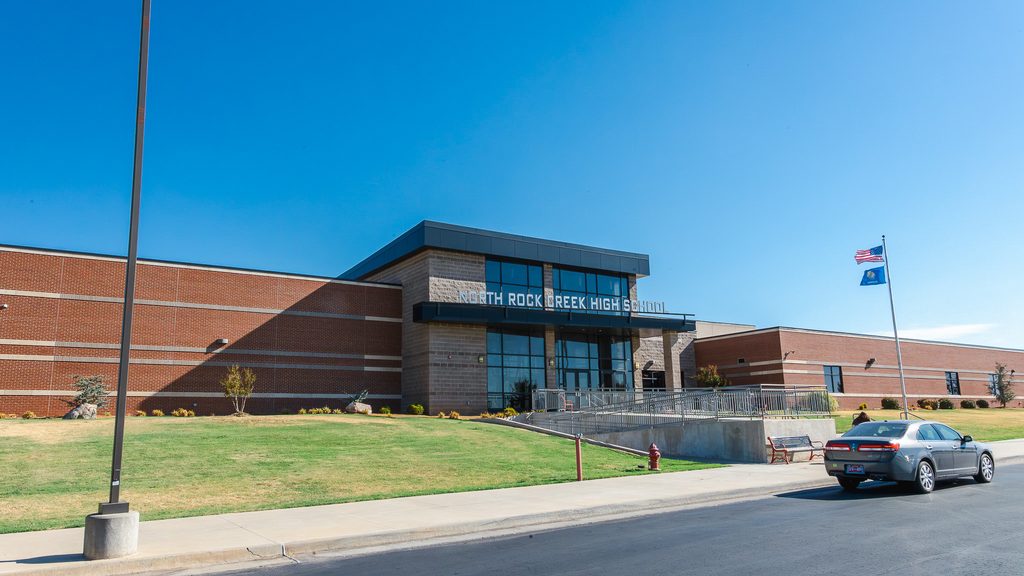
“We start back in the spring with a night where parents and kids can come, and then we have a spot on their course request form at the bottom that says, ‘Are you interested in concurrent for next year?’” Moody said.
From there, the counselors meet individually with interested students, review their eligibility, help them select courses and guide them through the enrollment process. They work closely with SSC Academic Advisor Cindy Nolen and maintain a detailed shared spreadsheet to track students, courses and enrollment requirements.
“And then we start pulling those kids in one at a time,” Barnett said.
The support continues after enrollment. Instead of requiring students to complete their online college coursework independently at home, North Rock Creek provides a dedicated classroom where concurrent students can work during the school day.
Certified teacher Tessa Russell manages the classroom, which serves students throughout the day. She helps them access SSC systems, set up two-factor authentication, locate student identification information, monitor email and understand the expectations of an online college course.
“She helps them get everything set up,” Barnett said. “And then she checks their grades every week, too.”
Students show Russell their current grades, and she alerts the counselors if a student begins falling behind. As participation has grown, North Rock Creek has assigned additional teachers with available class periods to supervise groups of concurrent students. When possible, students are placed with teachers whose subject areas align with their college courses.

The arrangement gives students the flexibility of online learning without removing the structure and support of the high school. It also allows students to remain on campus and participate in athletics, organizations and other activities instead of losing a significant portion of the school day traveling to and from a college campus.
Most students qualify for concurrent enrollment through ACT or PreACT scores, while others may complete a placement test. North Rock Creek reinforces that preparation through schoolwide testing opportunities. Freshmen take the PreACT 8/9, sophomores take the PreACT, juniors take the PSAT and seniors receive another opportunity to complete the ACT at no cost.
“Our kids are qualifying,” Moody said. “They have the ACT scores or the PreACT scores.”
Concurrent enrollment is one part of North Rock Creek’s broader Individual Career Academic Plan process. Commonly known as ICAP, the process helps Oklahoma students identify their interests and skills, establish postsecondary and workforce goals and create a personalized roadmap for life after high school. An ICAP can incorporate assessment results, an intentional sequence of courses, concurrent enrollment and work-based learning experiences such as internships, mentorships and job shadowing.
Barnett and Moody meet with students individually or in small groups to discuss their plans and connect their coursework to possible careers. Russell also oversees the high school’s internship program, matching students with opportunities related to their interests.
North Rock Creek students have completed internships in dental offices, at SSM Health, in elementary classrooms, through the district’s child care program and with Joe Cooper Ford. The placements have allowed students to explore dentistry, health care, education, child care and the automotive industry before committing to a college major or career path.
“Just whatever their interests are,” Barnett said.
Barnett and Moody have worked at North Rock Creek since 2016, arriving as the district was preparing to expand beyond eighth grade. In the decade since, the high school has paired rapid growth with significant academic achievement.
Since graduating its first class, North Rock Creek has produced three Oklahoma Academic All-State honorees: William Noah McMullan in 2022, Kathrine Grant in 2024 and Liz Swindell in 2025. Grant and Swindell were also named National Merit finalists.
Asked what has driven the school’s early academic success, Moody pointed to the entire North Rock Creek community.
“Our teachers, our students and our families,” Moody said.
Beginning with the fall 2026 semester, eligible North Rock Creek concurrent students also benefit from SSC’s automatic scholarship for students in its five-county service area. After students qualify for the state concurrent tuition waiver, the scholarship covers their remaining fees and textbooks for up to nine credit hours for juniors and 18 credit hours for seniors.
North Rock Creek is located in Pottawatomie County, one of the five counties covered by the initiative. The scholarship is funded through the Scott Empowerment Fund, an endowed fund established following the SSC Educational Foundation’s $17 million gift from MacKenzie Scott’s Yield Giving.
Barnett and Moody said most of North Rock Creek’s 100 SSC students had already enrolled before they learned that their fees and textbooks would be covered. The figure, therefore, reflects a concurrent-enrollment system that was already operating at a significant scale before the new financial assistance became available.
North Rock Creek’s growth is expected to continue. In February, district voters approved a $32 million no-tax-increase bond issue to construct new elementary and secondary buildings. If funding permits, plans also include a high school expansion with innovative science laboratories, a black box theater, a living history classroom and additional physical education facilities.
For a high school that graduated its first senior class only four years ago, the bond represents another phase of growth already visible in a classroom where 100 students are working toward high school diplomas and college degrees at the same time.