In 1942, Seminole school Superintendent John G. Mitchell asked local families to consider what their junior college meant to the community. Near the end of his appeal, he posed a direct question.
“Do you want it to continue?”
The question appeared in the Aug. 27 Seminole Producer, less than nine months after the United States entered World War II. The college that would become Seminole State College was only 11 years old, and the war was testing its ability to keep local students in the classroom.
Mitchell’s argument connected education at home with the demands of wartime. Families could save money by enrolling their children at Seminole Junior College and use the difference to purchase Defense Bonds. Students could continue their education in familiar surroundings, prepare for further study and receive training they might otherwise be unable to afford.
He also reminded readers that the college belonged to them. Its value extended to their children, their city and the surrounding communities.
Within weeks, the college was preparing to serve another wartime need.
On Sept. 9, 1942, the Producer announced that Seminole Junior College had been designated to sponsor an engineering, science and management war-training program under the University of Oklahoma. An organizing meeting was scheduled for that Friday evening in the high school auditorium.
O. D. Johns, then principal of Seminole High School, encouraged residents to attend. The program was intended to prepare people for defense-industry jobs and help those already employed qualify for more responsible positions. It also offered a way for workers in other fields to prepare for defense work.
Women were especially encouraged to participate as military service drew more men away from civilian employment. The U.S. Office of Education would pay the instructional costs, while students would furnish their own textbooks and supplies. Separate typing and shorthand classes were also being offered for a small fee.
A second item on the same newspaper page reported that the college had been approved and recognized for Army and Navy Reserve students.
The announcements placed technical education and military preparation alongside the college’s traditional coursework. Its regular enrollment, however, continued to shrink.
State education reports recorded 132 students in 1941-42, 85 in 1942-43 and just 34 in 1943-44. Student-fee receipts fell from about $2,107 to $1,009 between the latter two years. The number of diplomas awarded dropped from six to one.
The college continued operating in Seminole High School, using school-district facilities. Elsewhere in Oklahoma, municipal junior colleges were closing or suspending operations as students disappeared from their classrooms.
Seminole remained open.
On March 20, 1946, the Producer published a headline that captured both the difficulty of the preceding years and the college’s next ambition: “Seminole Junior College, One of Six To Survive War, Will Enlarge Schedule.”
The six-college distinction referred to Oklahoma’s municipal junior colleges, the locally operated institutions associated with public school systems. Seminole was among the six that maintained continuous operations through the war.
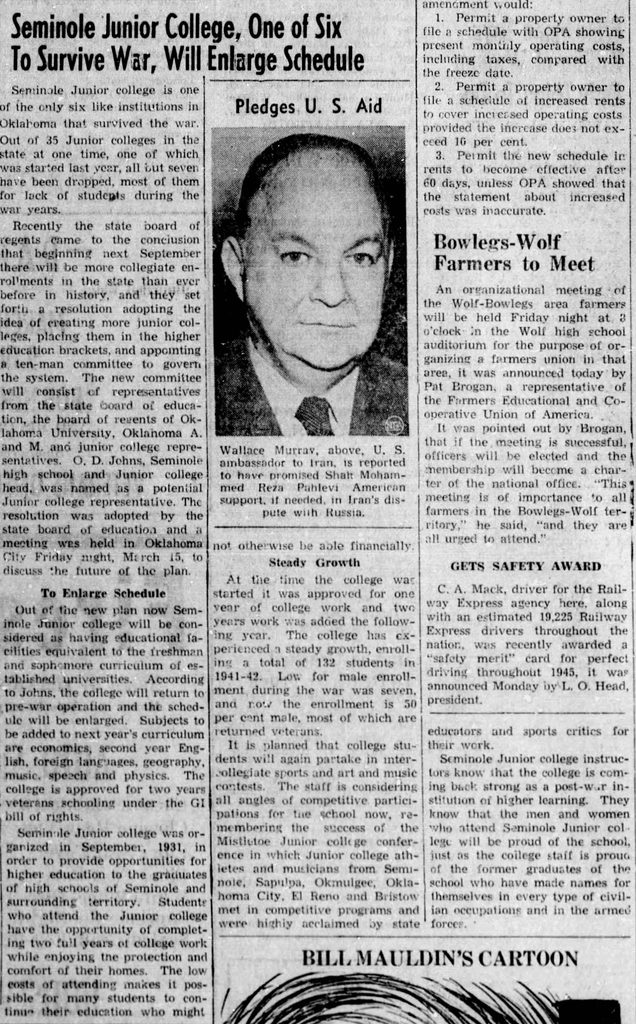
The same article supplied a stark measure of the wartime losses: At its lowest point, the college’s male enrollment had fallen to seven.
By March 1946, men again accounted for half of the student body. Most of those men were returning veterans. The college was approved to provide two years of schooling under the GI Bill, giving former servicemen a way to begin or resume higher education close to home.
Johns, then the Superintendent of Seminole Public Schools and the head of the college, outlined plans to restore prewar operations and broaden the schedule. Proposed subjects for the following academic year included economics, second-year English, foreign languages, geography, music, speech and physics.
Faculty members were also considering a return to intercollegiate sports and art and music contests. The newspaper recalled Seminole’s earlier participation in the Mistletoe Conference, when students competed with other municipal colleges across the state.
The proposed expansion would restore opportunities for students to study, compete and represent their college after years of contraction.
By 1947-48, reported enrollment had reached 116. Seminole was still a small college housed within a public school system, but its classrooms were filling again.
Mitchell’s 1942 appeal had asked families to consider whether their college should continue. When veterans returned to Seminole after the war, they found it still operating, ready to help them continue their education.