Terry Morris remembers a college gathering place where students played spades and teachers joined them for Cokes and candy bars.
It was the basement of First Presbyterian Church.
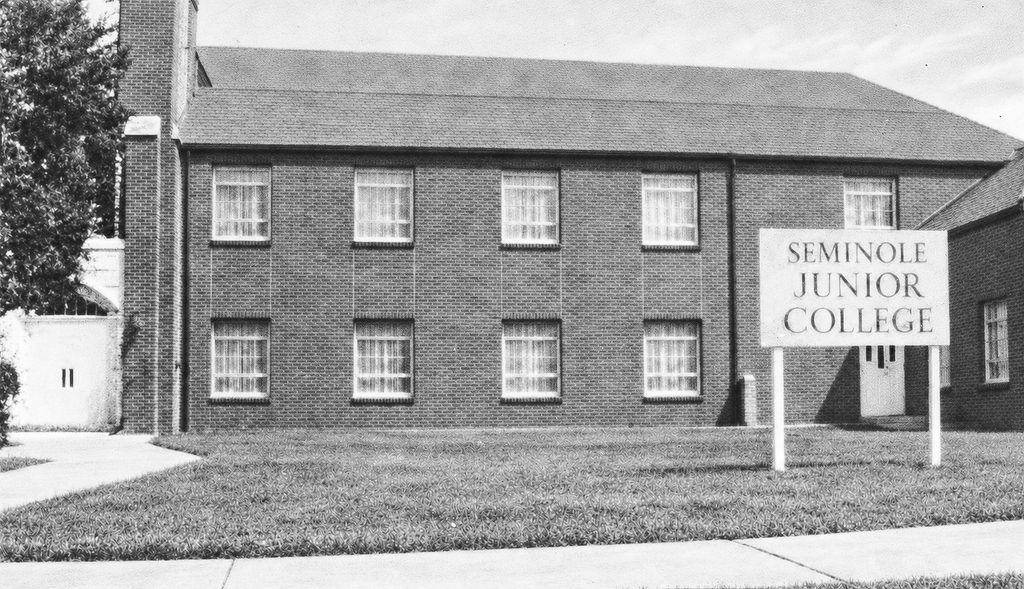
For two academic years, the church housed Seminole Junior College as it separated from the high school and prepared a campus of its own. Sunday school rooms became college classrooms. The pastor’s study served as the president’s office. The basement became the student union.
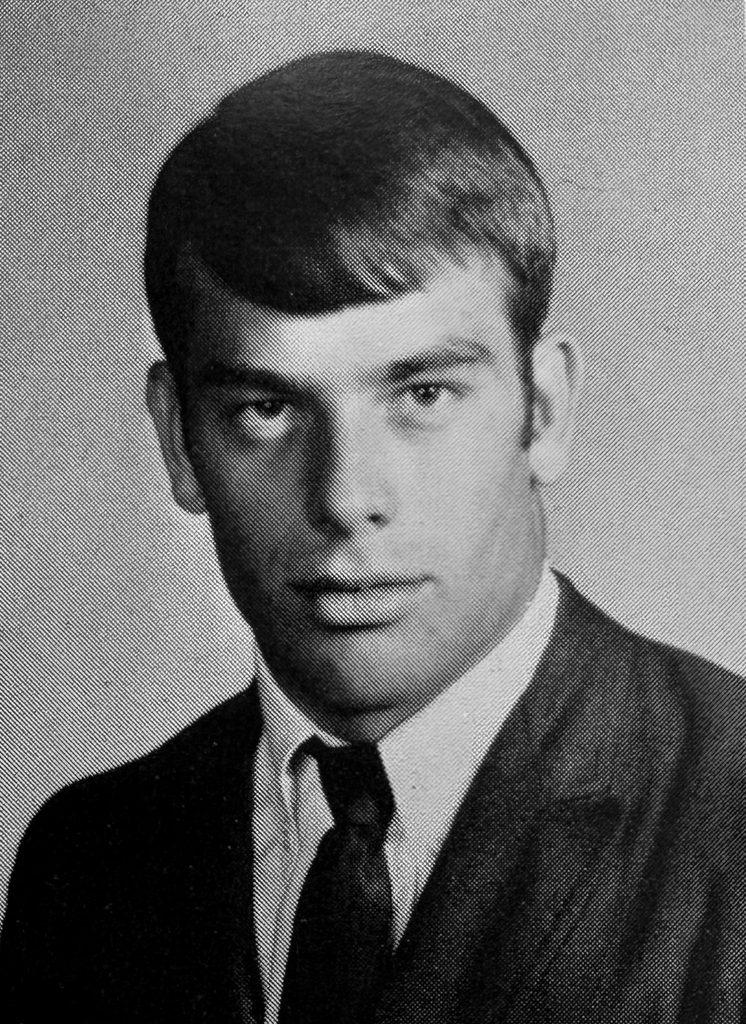
Morris, a 1970 Seminole High School graduate, attended during that transition. He earned his associate of science degree in 1972 as part of the first graduating class after the permanent campus opened. He went on to spend about 37 years in law enforcement, including 31 years with the Oklahoma Highway Patrol.
The college was only four or five blocks from his home. He remembers fellow students who were veterans, people balancing classes with work and instructors who would give students grace if they needed to miss a class to earn some money.
“I mean, it was more like family. It truly was,” Morris said.
The church years marked a turning point for the institution now known as Seminole State College. A state requirement to separate college operations from the high school had become an accreditation crisis. Keeping the college open required action in Oklahoma City and a commitment from Seminole residents to help pay for its future.
Elmer Tanner, who became president of the reorganized college, later documented the transition in his 1977 doctoral dissertation. His account traces the decisions that brought the college to the church and, in 1971, to the building later named Tanner Hall.
The requirements began with Senate Bill 2, enacted in 1967. The law established a framework for community colleges and state aid. David Boren, then a state representative from Seminole, appears among its House coauthors in the Oklahoma Senate Journal.
For Seminole, implementing the law meant establishing a college with its own philosophy, purpose, administration, curriculum, facilities and governing board, separate from the high school.
On Nov. 13, 1968, E.T. Dunlap, Chancellor of the Oklahoma State Regents for Higher Education, wrote to college administrator and Seminole Public Schools Superintendent H.B. Mitchell requesting a plan for meeting those requirements.
“The administration did not act on this request,” Tanner wrote.
Dunlap followed up Dec. 16, again asking Mitchell for the items he had requested. By the following spring, the consequences extended beyond the unanswered requirements.
An accreditation team’s March 13, 1969, report recommended against accrediting Seminole Junior College. Its concerns included library resources, the sharing of high school personnel and accounting, and the need for a distinct college faculty and identity.
According to Tanner’s account, Dunlap called Boren to his office and told him the college would not be accredited. Boren was the first person outside the college administration to learn of the decision. He returned to Seminole and informed Milt Phillips, publisher of The Seminole Producer.
Boren and Phillips joined state Sen. Al Nichols of Wewoka and Seminole school board President Hubert Callaway in a delegation to the State Regents. They sought the steps Seminole needed to take to retain accreditation. The Regents agreed to one year of provisional accreditation in which the college could substantially meet the recommendations.
That gave Seminole time to reorganize. Boren and Phillips brought the matter before the school board March 15.
The board voted unanimously to pursue the requirements and gave the junior college priority for a $250,000 bond election, scheduled for just ten days later, March 25.
The campaign moved quickly. The Chamber of Commerce held a rally in front of the Municipal Building, where Boren and local attorney Bill Wantland spoke in support of the college. Phillips promoted the proposal in his newspaper, and junior college students rallied behind it.
Phillips later credited the students with drawing residents into the campaign who seldom participated in civic efforts. Their enthusiasm had spread beyond the college. Seminole voters approved the bond by an 8-to-1 margin.
The vote committed local money to the college’s separation and new facilities. With accreditation at risk, Seminole residents had given the reorganization a way forward.
The local effort unfolded as Oklahoma considered the future of its remaining municipal colleges. In 1969, the Legislature asked the State Regents to study their conversion into state institutions through Senate Concurrent Resolution 36.
Dan Boren recalls his father working with Herschal Crow, a legislator from Altus, on college legislation benefiting their communities. Crow wanted support for the college in Altus, now Western Oklahoma State College.
“It was a deal between kind of east and west part of the state,” Dan Boren said.
In Seminole, the bond vote was followed by the work of building a separate institution. On April 14, Callaway, Emery Magruder and John Spurrier met with Dunlap’s staff about selecting a president. Dunlap recommended Tanner as a possible candidate.
Tanner took on the reorganization, hired faculty and sought temporary space. The college needed classrooms before it could complete a permanent campus.
The Seminole Producer publicized the search. First Presbyterian Church and the Church of God offered their buildings. Tanner and the new faculty inspected both, choosing First Presbyterian, 338 Russell Ave., because of its location, parking and building arrangement.
When the college trustees met with the minister and church board to discuss rental terms, the congregation offered the space rent-free and agreed to pay the utilities. The offer allowed the college to direct money toward instruction and equipment. Tanner later emphasized that the trustees had not asked for free use of the building. The church had volunteered it.
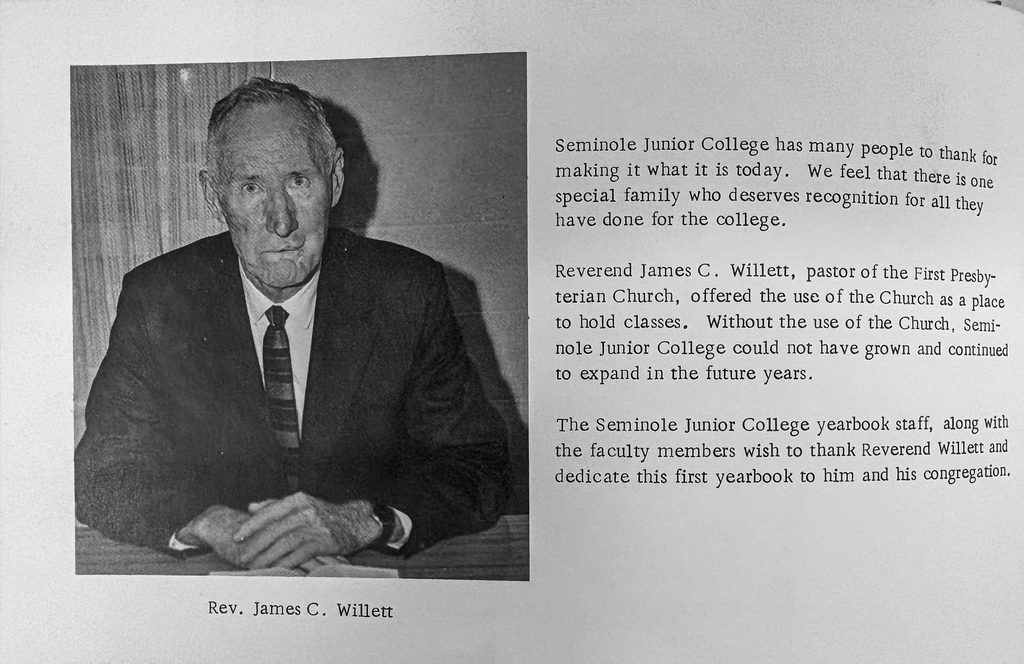
The Rev. James C. Willett was the church’s pastor. The college’s 1971 yearbook credited him with offering the church for classes and dedicated the volume to him and his congregation.
“Without the use of the Church, Seminole Junior College could not have grown and continued to expand in the future years,” the yearbook staff wrote.
Inside the church, the work involved fitting college functions into the rooms available. Tanner described three stories and a large basement, with space for nine classrooms on the third floor. The back of the sanctuary on the main floor was designated for the library.
Equipment was moved out of Sunday school classrooms and replaced with student desks. The pastor’s study became Tanner’s office six days a week. Downstairs, students had a place to gather between classes.
The trustees authorized an $18,000 library collection from Xerox, payable over three years. Desks, chalkboards and science equipment were also purchased on deferred terms. The arrangement gave the college the resources it needed to begin teaching in its temporary quarters.
The number of students using those rooms grew quickly. Tanner described a student body of 89 in spring 1969, before the move out of the high school. He reported enrollment of 364 during the college’s first year in the church, 1969–70, and 604 in its second year, 1970–71.
Morris’s memories of those early college years also include helping with plays. Connie Clawson taught humanities, journalism and drama. When she needed extension cords, Morris remembers going to Bob Webster at Webster’s Electric and explaining that the college had no money for them. Webster made the cords and gave them to him.
Morris knew Webster through freight deliveries. He also remembers borrowing his father’s pickup to haul materials for a play, fitting the work around the family’s delivery business.
“People just stepped up and helped out,” Morris said.
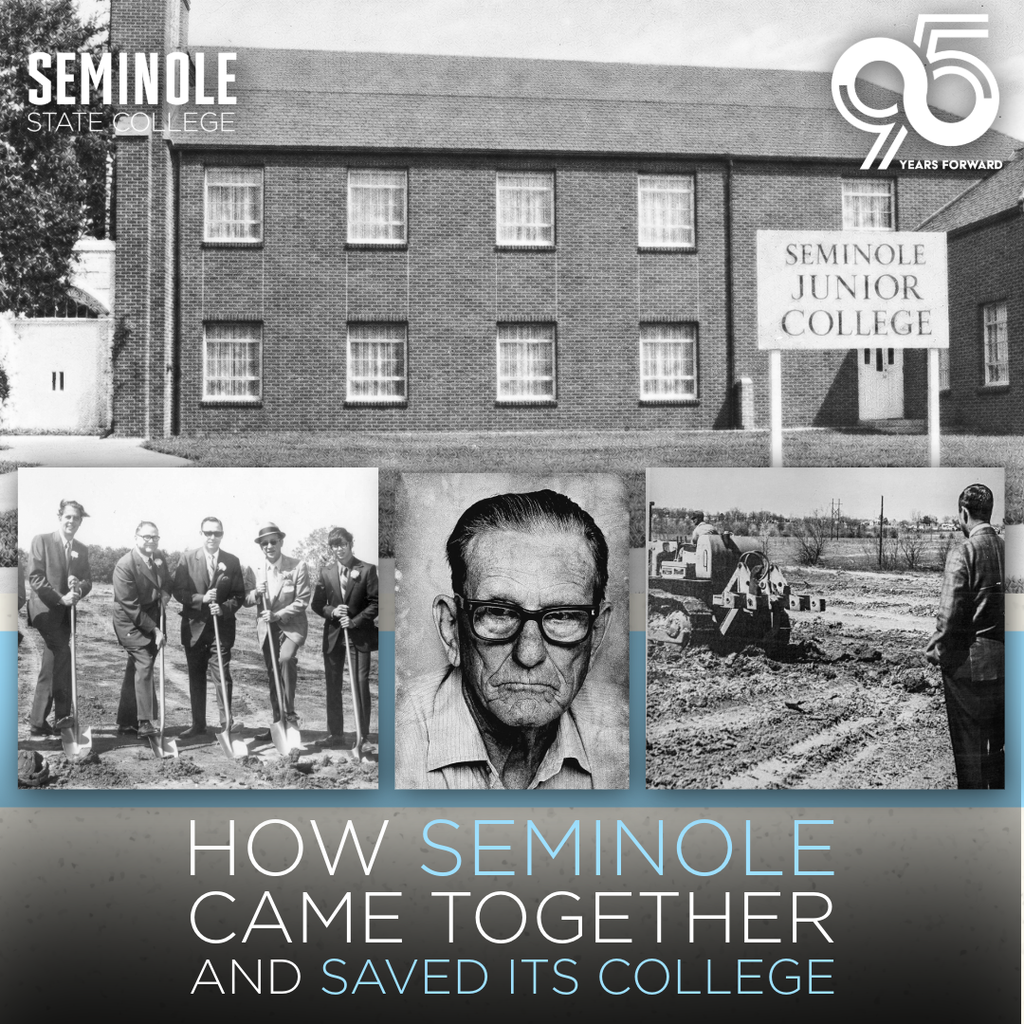
While students attended classes at the church, the college planned its permanent home. The city of Seminole donated the initial 40 acres for the campus at the intersection of State Highways 9 and 3. The trustees hired an architectural firm July 10, 1969, and accepted a design Aug. 11. The first building was planned to handle classroom and administrative functions within approximately 27,500 square feet.
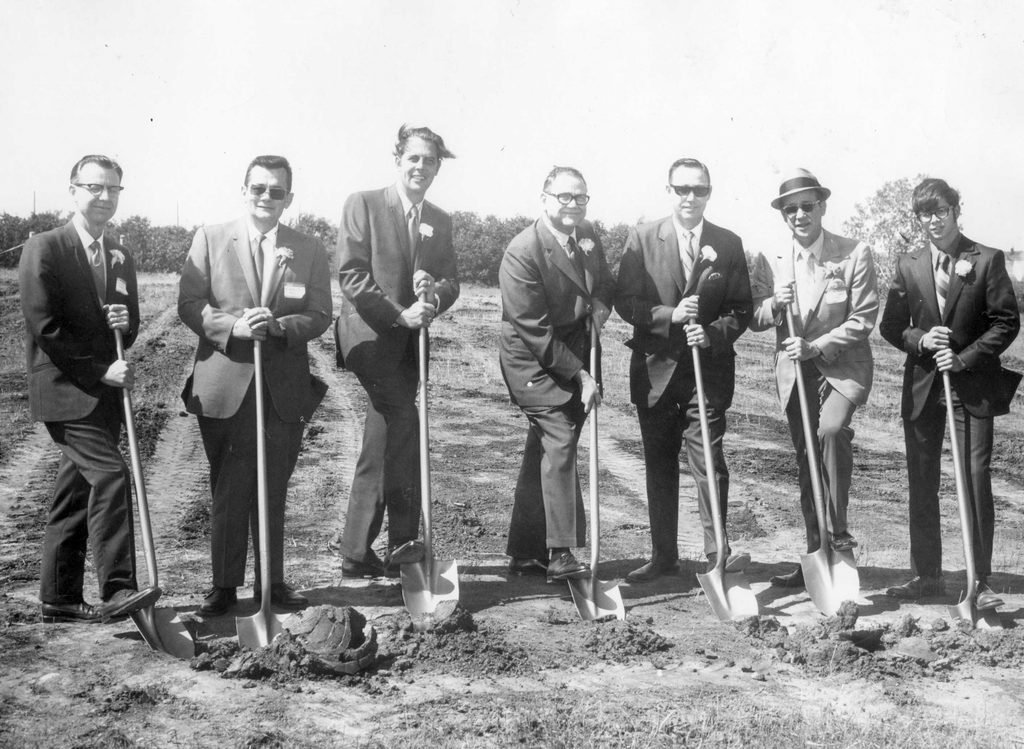
Groundbreaking followed in September 1970. But the college still needed a dependable source of local funding to operate and maintain what the community was building.
An examiner for the North Central Association of Colleges and Schools, visiting in October 1970 as part of the regional accreditation process, identified local financing as an unresolved requirement. Tanner proposed an additional one-cent city sales tax for the college’s operation, maintenance and improvements.
Tanner, Callaway and the president of the college’s Student Senate took the proposal to the City Council. Council members unanimously called an election for March 23, 1971.
Students again helped carry the campaign into town. The Student Senate organized a car caravan to downtown Seminole, where students went from business to business asking permission to display posters urging a yes vote.
They also went door to door, asking residents whether they would support the tax. On election day, they contacted those supporters again and urged them to go to the polls.
Phillips advocated for the measure in The Seminole Producer. Mayor Waldo Lilly, Chamber of Commerce leaders, local bankers and civic organizations joined the effort to secure the college’s financial support.
Voters approved the tax by a 2-to-1 margin. Phillips celebrated the decision in his “Cluttered Corner” column, writing, “One thousand and three citizens of Seminole have shown the way to greatness in this community.”
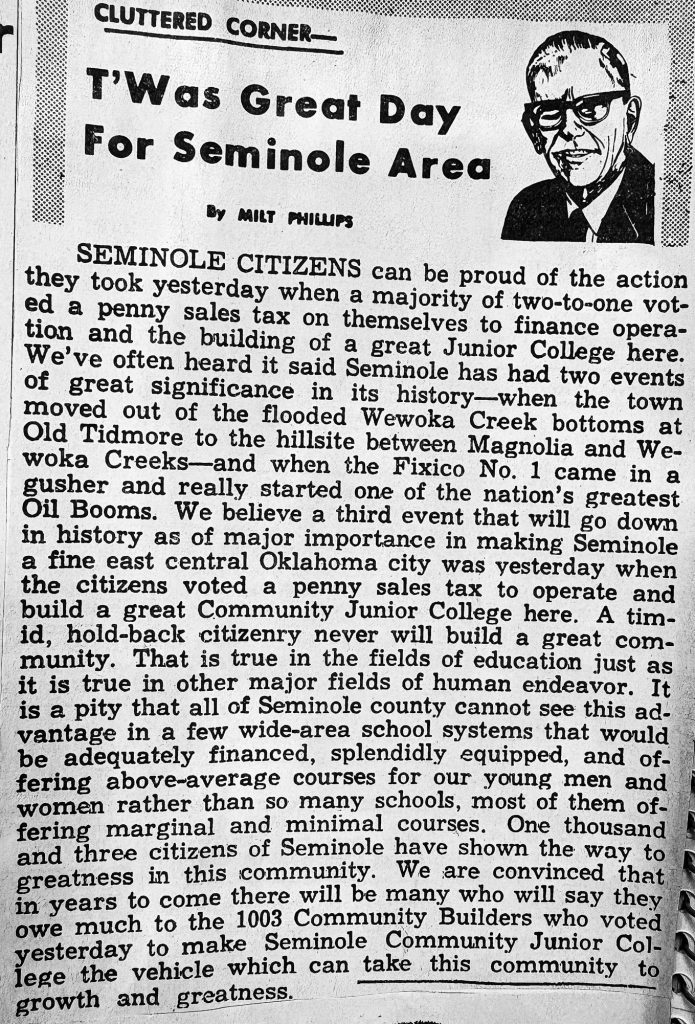
Two years after approving the bond, Seminole residents had again committed their own tax dollars to the college’s future. The bond helped finance the new campus; the sales tax would help sustain the college operating there.
Less than three weeks later on April 8, Tanner described Seminole’s circumstances at a public hearing U.S. Sen. Fred Harris held in Tulsa on the proposed Comprehensive Community College Act.
He described a $790,000 first phase of construction and students whose ability to attend depended on having a college nearby. Even as that first building rose, he warned that “we are going to outgrow our present facilities before they are even completed.”
The college moved into its first permanent building in August 1971, before the new academic year. The structure brought classrooms and administrative offices together on the dedicated campus. It would later bear Tanner’s name.
Morris had known the college in rooms shared with a congregation. When asked how it felt to walk into the new building, he responded, “It felt like we just went into a brand-new home.”