Across a 50-year career in education, Johns guided Seminole schools through an oil-boom transformation, wartime uncertainty and the beginning of desegregation while helping preserve the community’s junior college.
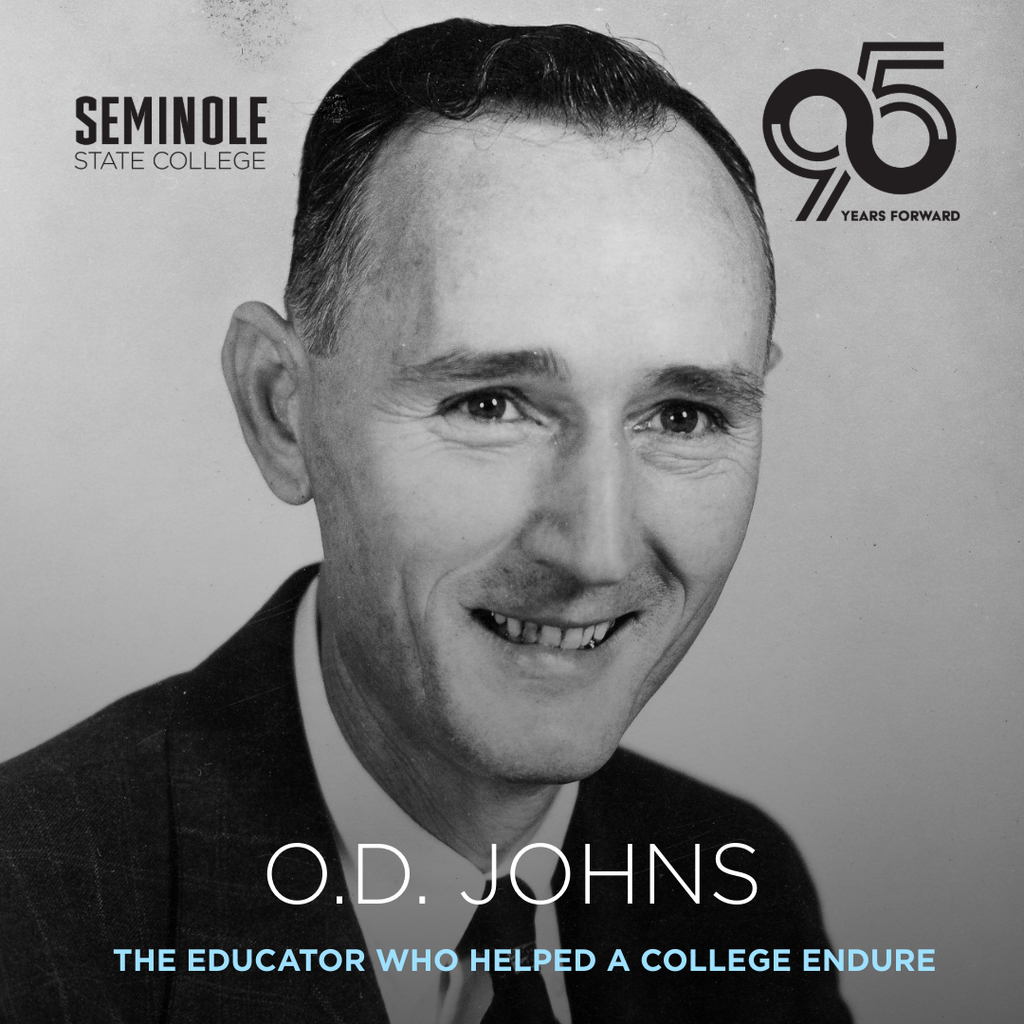
For more than three decades, Oliver Daniel “O.D.” Johns was one of the central figures in Seminole education. He arrived in 1927, became principal of Seminole High School in 1931, administered Seminole Junior College through the lean years of World War II and served as superintendent of Seminole Public Schools from 1945 to 1959.
His career in Seminole spanned the city’s transition from an overcrowded oil-boom community to an established school district. It also helped sustain a small municipal college that offered generations of local students a path into higher education.
Johns was born Feb. 6, 1904, in Collinsville, Texas. He earned a bachelor’s degree in mathematics from Oklahoma Baptist University in 1923 and began a career in public education that would last half a century. Four years later, he moved to Seminole to serve as principal of the city’s elementary and junior high school.
The town he entered was still contending with the disorder and rapid growth of the oil boom. His elder son, Oliver Davis Johns, now 91, grew up hearing stories of muddy streets and a rough district known as Bishop’s Alley. By his own childhood, however, he remembered Seminole as “a very prosperous little town with lots of oil well supply businesses.”
“It was a very fine place to be a kid,” he said.
In 1931, O.D. Johns became principal of Seminole High School and married Mary Avolyn Davis, a music teacher. They raised two sons, Oliver Davis and James Stephen. Johns continued his education while working, earning a master’s degree in education from the University of Oklahoma in 1933.
The year he became high school principal was also the year Superintendent John G. Mitchell organized Seminole Junior College. The new institution opened with 51 students and operated as part of the public school system. It had no separate campus; its classes were held on the third floor of Seminole High School.
As principal, Johns became the college’s administrative officer. His son said Mitchell delegated the day-to-day responsibility to him.
“As far as I know, the principal of the high school had the administrative responsibility for the junior college,” Oliver Davis Johns said.
That role grew more consequential during World War II. Enrollment at Seminole Junior College fell from 132 students in 1941-42 to 85 the following year and just 34 in 1943-44. Municipal junior colleges across Oklahoma closed or suspended operations, but Seminole was one of six that remained open continuously through the war.
The surviving record provides only glimpses of Johns’ work during those years. In 1942, the college became an elementary glider-training center in the Civilian Pilot Training Program. A newspaper notice recruiting students for the eight-week course directed applicants to O.D. Johns.
His family remembered the larger result more clearly than the specific measures he took.
“My father was the administrative officer of Seminole Junior College during the war, and he saved it,” his son said.
The college survived and rebuilt after the war, enrolling 116 students in 1947-48. By then, Johns had succeeded Mitchell as superintendent of Seminole Public Schools. He would lead the district for 14 years while continuing to oversee the junior college.
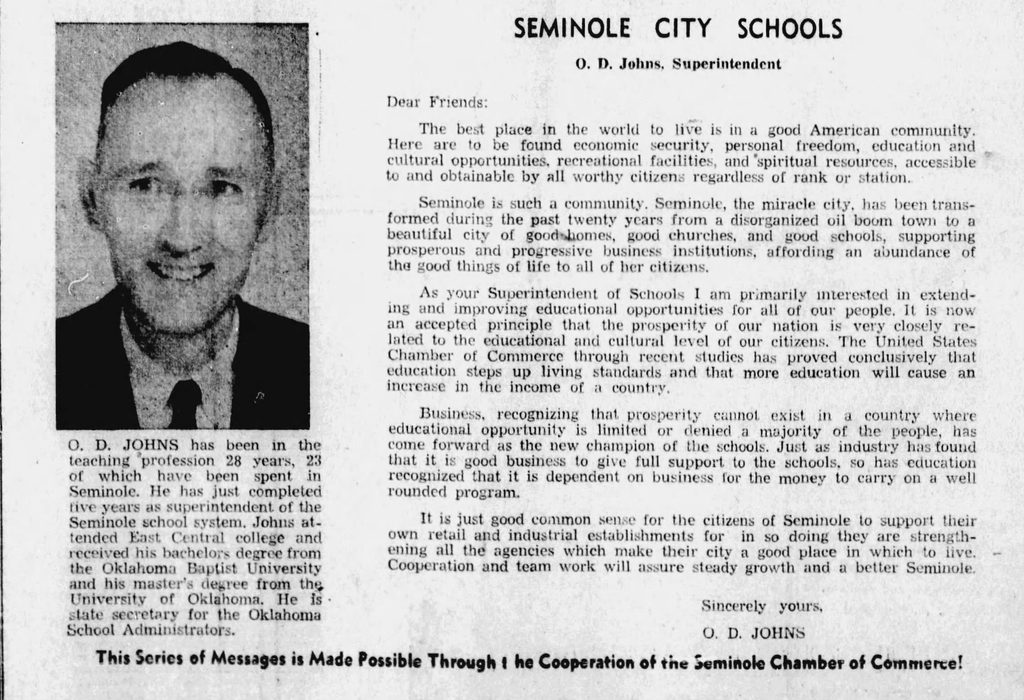
Beyond his administrative work, Johns emerged as a leader in both his profession and the community. He served as president of the Oklahoma Association of School Administrators and was a charter member and past president of the Seminole Rotary Club. He was active in the Chamber of Commerce, received the Boy Scouts of America’s Silver Beaver Award and promoted tennis in Seminole, helping secure school courts for the sport.
“I think he was very well respected,” his son said. “He was a very dignified man and he had good relations.”
At home, that commitment to education was equally personal. O.D. Johns encouraged his elder son to finish high school a year early and attend Seminole Junior College during the 1951-52 school year. The younger Johns took advanced algebra and physics, working in the same third-floor laboratory used by high school students.
“The year that I spent as a junior college student was very, very good,” he said. “I think that it’s very important that I did this junior college year because by the time I got to MIT the next year, I was really well prepared.”
Oliver Davis Johns entered the Massachusetts Institute of Technology in 1952 and graduated in 1956. Near graduation, his father contacted Savoie Lottinville, director of the University of Oklahoma Press and a former Rhodes Scholar, to ask about a Rotary fellowship. Lottinville instead encouraged the young man to apply for a Rhodes Scholarship. He won the award and studied at Balliol College at the University of Oxford.
He later became a physicist, a professor at San Francisco State University and the author of Analytical Mechanics for Relativity and Quantum Mechanics. Looking back, he connected that career to the preparation he received in Seminole and to his father’s determination to keep educational opportunities available close to home.
“And this little town in Seminole, this little town of Seminole did that,” he said. “That’s truly extraordinary.”
Johns’ years as superintendent also included the beginning of desegregation in Seminole schools. In June 1955, the Board of Education announced that Black applicants would be admitted to Seminole Junior College on the same basis as white applicants. Two Black students were enrolled by fall 1956. His son summarized his father’s response directly: “When the order came to integrate the schools, my father did. He integrated them.”
In 1959, Johns completed his doctorate at OU and left Seminole to become a professor and associate dean of education at the university. His work broadened from local administration to statewide policy. A 1970 state report credited him with developing a new local-state school finance plan for Oklahoma with support from the Oklahoma Education Association’s legislative committee.
Johns retired in 1972 after 50 years in education. He died Feb. 29, 1996, at age 92.
His son’s accomplishments became one measure of the opportunities Johns worked to preserve. Another is the college itself, which moved beyond the third floor of the high school and eventually became Seminole State College.
“So I’m glad that the junior college got saved so that I could use it,” Oliver Davis Johns said.