
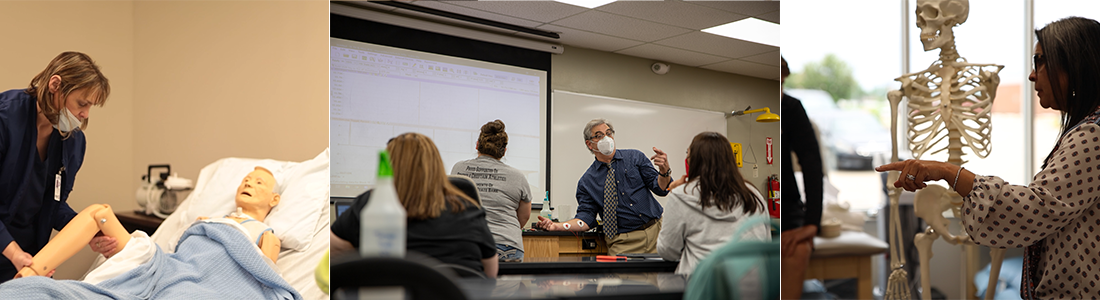
Health Sciences Division
The Health Sciences Division provides programs in Medical Laboratory Technology, Nursing, and Physical Therapist Assistant. The divisional faculty and staff invite you to explore the opportunities in these exciting and rewarding healthcare fields.
What is possible with a Health Sciences degree?
Health Sciences is one of the broadest career areas because it includes direct patient care, laboratory work, imaging, rehabilitation, healthcare administration, and public health. Starting at an Oklahoma community college can be a strong option because many health programs are designed as career-entry programs (you can begin working after 1–2 years) or as transfer pathways toward bachelor's and graduate healthcare careers.
Health Science Careers in Oklahoma
| Career | Community College Pathway | Typical Oklahoma Salary Range* | Education Level |
|---|---|---|---|
| Licensed Practical Nurse (LPN) | Certificate/Diploma (≈1 year) | ~$45,000–$60,000 | Certificate + license |
| Registered Nurse (RN) | ADN (≈2 years) | ~$65,000–$90,000+ | Associate + license |
| Radiologic Technologist | AAS (≈2 years) | ~$55,000–$75,000 | Associate + certification |
| Respiratory Therapist | AAS (≈2 years) | ~$60,000–$80,000 | Associate + certification |
| Medical Laboratory Technician | AAS (≈2 years) | ~$50,000–$70,000 | Associate + certification |
| Physical Therapist Assistant | AAS (≈2 years) | ~$55,000–$75,000 | Associate + license |
| Occupational Therapy Assistant | AAS (≈2 years) | ~$55,000–$75,000 | Associate + license |
| Dental Hygienist | AAS (≈2–3 years) | ~$75,000–$95,000 | Associate + license |
| Health Information Technologist | Associate/Bachelor’s | ~$45,000–$75,000 | Associate/Bachelor’s |
| Healthcare Administrator | Bachelor’s preferred | ~$65,000–$110,000+ | Bachelor’s+ |
*Salary ranges are approximate Oklahoma estimates; wages vary by metro area, employer, experience, and specialty. Primary sources include the U.S. Bureau of Labor Statistics (BLS) Occupational Employment and Wage Statistics and Occupational Outlook Handbook.
Registered Nurse (RN)
Typical entry point: Community college ADN program (2 years)
What RNs do
- Provide direct patient care
- Administer medications
- Monitor patient conditions
- Educate patients and families
- Coordinate healthcare teams
Common employers
- Hospitals
- Clinics
- Long-term care facilities
- Home health agencies
- Schools
- Public health departments
Qualifications
- Associate Degree in Nursing (ADN)
- NCLEX-RN exam
- Oklahoma RN license
- CPR/BLS certification
Skills
- Patient assessment
- Critical thinking
- Communication
- Documentation
- Medical terminology
- Teamwork
- Technology skills
Career growth
RN → Charge Nurse → Nurse Manager → Clinical Director
Further options:
- BSN
- Nurse Practitioner
- Nurse Educator
- Nurse Administrator
Licensed Practical Nurse (LPN)
Typical entry point: Certificate program (about 1 year)
What LPNs do
- Provide basic nursing care
- Monitor patients
- Assist with medications and treatments
- Support RNs and physicians
Work settings
- Nursing homes
- Clinics
- Hospitals
- Home health
Qualifications
- Approved practical nursing program
- NCLEX-PN license exam
Career growth
LPN → RN bridge program → Advanced nursing roles
This can be a fast entry point into healthcare for students who want to begin working quickly.
Medical Laboratory Technician (MLT)
Typical entry point: Associate degree
What they do
- Analyze blood, urine, and tissue samples
- Perform diagnostic testing
- Support physicians in diagnosing disease
Work settings
- Hospitals
- Diagnostic laboratories
- Clinics
- Research facilities
Qualifications
- Accredited MLT program
- Certification may be preferred
Skills
- Laboratory procedures
- Quality control
- Data accuracy
- Biology and chemistry
Physical Therapist Assistant (PTA)
Typical entry point: Associate degree
What they do
- Help patients recover movement and strength
- Assist with rehabilitation exercises
- Track patient progress
Common settings:
- Rehabilitation centers
- Hospitals
- Outpatient clinics
Qualifications
- Accredited PTA program
- State licensure
Career growth
PTA → Physical Therapist (requires doctoral education)
Healthcare Administration
Typical pathway
Community college AA/AS → Bachelor's in Healthcare Administration or Business
What they do
- Manage healthcare operations
- Coordinate services
- Support budgeting and compliance
- Improve patient systems
Possible roles:
- Medical office manager
- Health services coordinator
- Practice administrator
Skills
- Leadership
- Healthcare regulations
- Data analysis
- Communication
- Organization
Further Education and Certifications
- Associate Degree in Nursing (ADN)
- Licensed Practical Nursing (LPN)
- Radiologic Technology
- Respiratory Therapy
- Medical Laboratory Technology
- Physical Therapist Assistant
- Occupational Therapy Assistant
- Dental Hygiene
- Health Information Technology
For students who want advanced careers:
- Bachelor of Science in Nursing (BSN)
- Health Sciences bachelor's degree
- Public Health
- Healthcare Administration
- Biology/Pre-Medicine pathway
- Physician Assistant (PA)
- Nurse Practitioner (NP)
- Physical Therapist (PT)
- Occupational Therapist (OT)
- Physician (MD/DO)
- Healthcare Administrator
Job Market Outlook in Oklahoma
Health Sciences is expected to remain a strong employment area because of:
- Oklahoma's aging population
- Growth in chronic disease management
- Expansion of outpatient healthcare
- Demand for rural healthcare workers
- Retirements among current healthcare professionals
The strongest demand areas are generally:
- Registered nursing
- Allied health professions (imaging, respiratory therapy, laboratory)
- Rehabilitation services
- Home health and long-term care
BLS projects continued growth in many healthcare occupations nationally, with healthcare and social assistance among the fastest-growing industries. Oklahoma labor-market projections also identify many healthcare occupations among those with significant annual openings due to both growth and replacement needs.
Choosing a Health Sciences Path
- A career you can enter in 1–2 years
- Hands-on work helping people
- Strong job stability
- A pathway to advance later
Consider your goals:
- Want the most career flexibility? → RN
- Want a faster entry into healthcare? → LPN, MLT, Radiology
- Like technology and equipment? → Radiologic Technology or Respiratory Therapy
- Enjoy rehabilitation and coaching? → PTA or OTA
- Want leadership/business roles? → Healthcare Administration
- Identify your preferred patient-care level (hands-on care vs. technology/lab/administration).
- Compare Oklahoma community college programs and admission requirements.
- Complete prerequisite courses (often anatomy, physiology, biology, math).
- Gain healthcare exposure through volunteering, shadowing, or entry-level healthcare jobs.
- Choose a pathway that matches your desired timeline: 1 year, 2 years, or transfer to a bachelor's program.
Explore Degrees in Health Sciences
Health Sciences Enter-the-Workforce Degree Programs
Health Sciences Transfer Degree Programs
Health Sciences Online Degree Programs
Health Sciences Area of Emphasis Checklists
Division Chair
Division Office: 405-382-9205